Practical guides : Buy-side, Sell-side, and Financing.
At Collaboration Capital, we support business leaders, buyers and investors at every stage of a corporate finance transaction. Here you'll find our expert analyses on business acquisition, sale and financing: M&A methodology, valuation, financial structuring and lessons learned from real-world deals.

The vendor loan guide
Understand how vendor financing works, its benefits, risks, and best practices for structuring a secure financing solution in a business acquisition or sale.
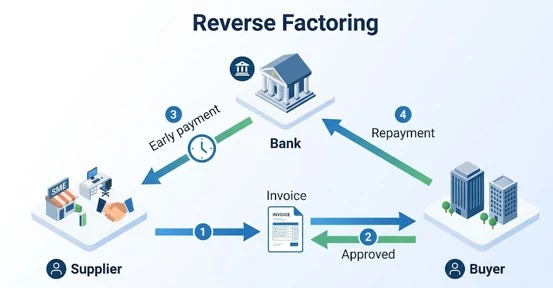
The Reverse Factoring guide
Finance your suppliers and secure your supply chain without increasing your working capital requirements

The instant business loans guide
Compare fast credit solutions and get a financing decision in less than 48 hours.
Acquiring a distressed business: the complete guide
From diagnosis to recovery plan: the complete method to buy at the right price without inheriting nasty surprises.
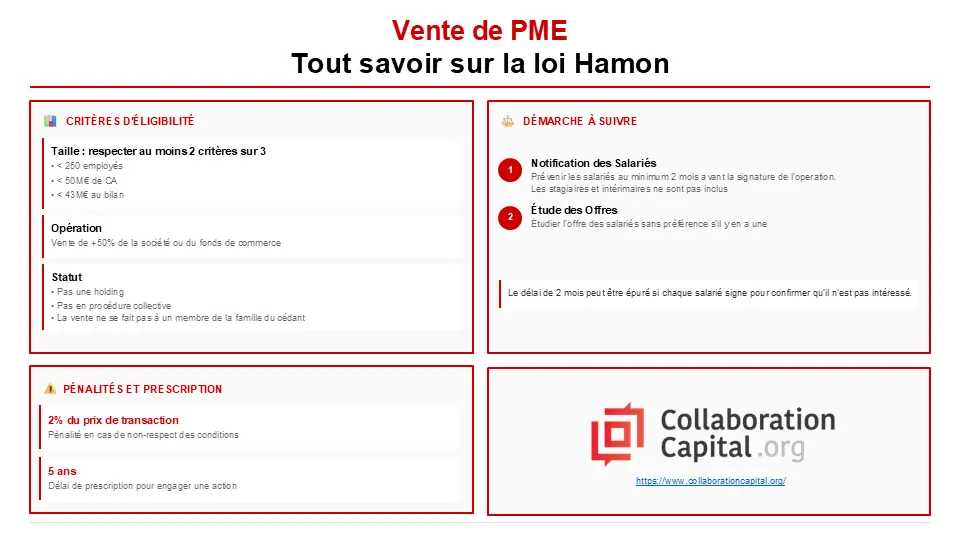
SME sale and the Hamon law: what the law says
Employee information obligation: your real obligations, the deadlines to meet and the risks of overlooking them.

Selling your business – the essential checklist
15 points to check before signing to sell at the best price and keep control of the negotiation.

Confidentiality & NDA: what really works
The confidentiality agreement template that genuinely protects your sensitive data during negotiations.

The letter of intent (LOI) in mergers and acquisitions
Draft a solid LOI: key clauses, legal scope and mistakes to avoid before committing.
The SPV Financing
Set up an SPV to finance an acquisition while ring-fencing risk: structure, benefits and legal framework.
Buying an Off-Market Company
Access the best off-market targets: less competition, better terms, and the risks to manage.

The factoring guide
Finance your cash flow by assigning your customer invoices: how it works, costs and concrete use cases.
Business acquisition: succeeding in external growth
Acquiring a company — through a buyout, external growth or takeover — allows you to accelerate your development, enter a new market or bring in a key capability. Our guides detail the stages of a successful acquisition: targeting, approach, letter of intent (LOI), due diligence and closing.
Business sale and transfer: maximising value and securing the sale
Selling your business is a strategic step that is often prepared several years in advance. From valuation to negotiation, including the preparation of documentation and the taxation of the transfer, our guides help business leaders maximise the value of their company while securing the transaction.
Business financing: the levers to fund your projects
Acquisition, growth, working capital needs: every project calls for a tailored financing solution. Our experts break down the main levers available to business leaders.
Financing a buyout or external growth
SPV structuring, senior debt, mezzanine debt or vendor loan: we explain how to structure the financing of an acquisition and activate leverage.
Financing the operating cycle: factoring and reverse factoring
Factoring, reverse factoring and cash flow solutions: discover how to finance your working capital needs and smooth your receivables.
Fast and alternative financing
Instant loans and alternative financing let you seize an opportunity without delay. Estimate your options in just a few minutes.
M&A method and tools: valuation, due diligence and artificial intelligence
Beyond the deals, we share our method: valuation methods (DCF, multiples, adjusted net asset value), conducting due diligence, legal structuring (SPV, representations and warranties) and the use of artificial intelligence to speed up your M&A analyses.
Frequently asked questions about business acquisition, sale and financing
What is the difference between an acquisition and a merger?
In an acquisition, one company buys another, which becomes a subsidiary or ceases to exist: control changes hands. In a merger, two companies combine to form a single entity. An acquisition pits a buyer against a seller, whereas a merger aims for a more balanced combination.

How is a company valued before a sale?
Three main families of methods coexist: the asset-based approach (adjusted net asset value), the cash-flow approach (DCF) and the analogical approach using multiples (comparison with comparable transactions or listed companies). In practice, several methods are combined to establish a value range.
What is a letter of intent (LOI) in M&A?
The LOI (Letter of Intent) formalises a buyer's interest and the main terms of the project: indicative price, scope, timeline, exclusivity and conditions precedent. Generally non-binding on the final price, it frames the due diligence before signing the definitive agreement.
What is an SPV and what is it used for in a buyout?
An SPV (Special Purpose Vehicle) is a structure created to carry a buyout transaction. It allows the acquisition debt to be ring-fenced, several investors to be brought together and the structure to be optimised through leverage (LBO).
How do you finance the acquisition of a company?
Financing a buyout generally combines equity contributions, bank debt (senior debt), sometimes mezzanine debt and a vendor loan. The structure often relies on leverage through an SPV. The choice depends on the size of the deal, the target's repayment capacity and the buyers' profile.
What are factoring and reverse factoring?
Factoring allows a company to assign its invoices to be paid immediately. Reverse factoring is initiated by the buyer: it allows its suppliers to be paid quickly while preserving its own cash flow. Both finance working capital needs.
How long does a sale or acquisition transaction take?
An M&A transaction generally spans 6 to 12 months from the first discussions to closing. The upstream preparation (valuation, documentation, legal housekeeping) can begin several years before the transaction.